
London Drainage Facilities (LDF) details exactly who is responsible for repairing our drains and sewers. Who is responsible for repairing drains? Generally, as a rule of thumb a homeowner is responsible for the drains that fall within the boundaries of their property and in the event of something going wrong, they will be required to...Continue reading→
How London’s Great Stink Heralded A Wonder Of The Industrial World
The Influence Of Bazalgette On London’s Sanitation
Bazalgette’s Victorian sewers were the solution to London’s Great Stink. Find out how flushing toilets and cholera contributed to this revolutionary design.
The population of London doubled during the first half of the 19th century and by 1850 there were more than three million citizens resident in the capital. Unfortunately, the city was not built to accommodate this mass of people and therefore problems with sanitation arose. Traditionally, human and animal waste were washed into the River Thames to be taken out to sea with the tide. However, the river couldn’t handle the sheer quantity of debris that it was burdened with, so it would overflow back into the streets of London.
Cholera Outbreaks
Not only were the piles of excrement along the highways of London disgusting, they were also unsanitary. Even more of a concern though was the contaminated drinking water which was piped directly from the Thames. Those that still used wells would find that they were located in the vicinity of cesspools which were overburdened from the recent introduction of flushing toilets in 1851. Many schools of thought correctly believed that water-borne diseases such as cholera, dysentery and typhoid were spread by swallowing this polluted water. Sadly, the inability to stop people drinking it cost the lives of more than 30,000 Londoners before 1854.
Political Intervention
By the summer of 1858, politicians based at the newly-built Houses of Parliament on the banks of the River Thames could no longer bear the stench. They made the decision to tackle the problem of London’s Great Stink. The newly formed Metropolitan Board of Works appointed engineer Joseph Bazalgette to design a sanitation system and £3 million was put aside for the project. Bazalgette was hungry to get to work on his construction plans as he had experienced several knockbacks in previous years when there was no budget in place.
Industrial Masterpiece
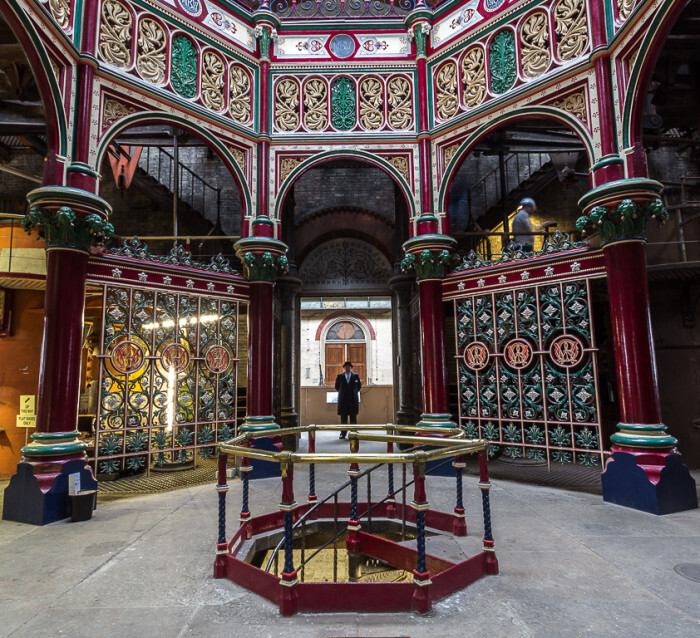
Bazalgette’s Victorian sewage system was an industrial masterpiece that paved the way for many other cities and countries to create their own drainage systems. His London sewers spanned 82 miles of underground tunnels which ran on a slight downhill gradient, parallel to the river. They picked up surface water and waste along the way and flowed to outfalls at the eastern end of the city. Elaborate pumping stations which were magnificent in design were erected at Chelsea, Deptford, Abbey Mills and Crossness (pictured above). They assisted the sanitation cycle by drawing up sewage from low-lying areas and pumping it towards the outfalls.
After Bazalgette’s system was introduced, cholera was almost immediately eradicated in London. A further bout did occur in East London in 1866 because, unfortunately, this was the only part of the capital that had yet to be connected to the sewers.
Inspiration
Joseph Bazalgette’s revolutionary design went on to inspire many other engineers from all over the world. He was responsible for providing counsel and engineering training in places such as Mauritius and Budapest. Over 150 years later, Bazalgette’s London sewers are constantly tested by an increase in population and climate changes. Regular upgrades and enhancements, as well as frequent drain maintenance, are required to keep the system in good working condition, but his creation still serves as the major backbone to the capital’s sanitation system.